Showing posts with label Valve Actuation. Show all posts

Advantages of Stainless Steel Body Pneumatic Rack & Pinion Actuators

Advantages of Stainless Steel Body Pneumatic Rack & Pinion Actuators

Stainless steel body pneumatic rack and pinion actuators have gained significant popularity in various industrial sectors due to their robust construction and reliable performance by combining the toughness of stainless steel with the efficiency of pneumatic operation, these actuators offer several advantages that make them suitable for demanding applications.

One of these actuators' primary advantages is their exceptional resistance to corrosion. Stainless steel protects against corrosion from exposure to harsh chemicals, moisture, and extreme temperatures. This quality makes these actuators ideal for chemical processing, pharmaceuticals, and food and beverage production, where equipment frequently contacts corrosive substances or requires regular washdowns.

Durability represents another significant benefit of these actuators. The stainless steel construction ensures long-term operational reliability, reducing the need for frequent maintenance or replacement. This durability translates into lower operational costs and increased productivity as minimal equipment downtime occurs. In industries where continuous operation remains critical, such as oil and gas or power generation, the reliability of stainless steel actuators becomes an invaluable asset.

These actuators also offer high performance in terms of torque output and speed. The rack and pinion mechanism efficiently converts the linear motion of the pneumatic piston into rotational motion, providing precise control over valve positions. This precision is crucial in applications that require accurate flow control, such as water treatment facilities or chemical dosing systems.

The hygienic properties of stainless steel make these actuators suitable for use in industries with strict sanitary requirements. Equipment in the food and beverage industry must adhere to stringent hygiene standards to prevent contamination. Operators can easily clean stainless steel actuators, which do not harbor bacteria, ensuring compliance with health and safety regulations. Similarly, in pharmaceutical manufacturing, maintaining sterile conditions is essential; stainless steel equipment supports this necessity.

Industries operating in extreme temperatures also benefit from stainless steel body pneumatic rack and pinion actuators. Stainless steel retains its mechanical properties over a wide temperature range, making these actuators suitable for cryogenic applications or high-temperature processes. For example, these actuators maintain consistent performance in power plants or refineries, where temperatures can fluctuate significantly.

Stainless steel body pneumatic rack and pinion actuators offer a combination of corrosion resistance, durability, precision, and safety. Industries that benefit most from these actuators include chemical processing, pharmaceuticals, food and beverage production, oil and gas, water treatment, and power generation. The unique advantages of stainless steel construction make these actuators reliable for applications that demand high performance and resilience in challenging environments. By investing in stainless steel actuators, industries can enhance operational efficiency, ensure compliance with regulatory standards, and achieve long-term cost savings through reduced maintenance and downtime.

UNITORQ
2150 Boggs Road
Suite 410
Duluth, GA 30096
Phone: 770-446-7074
Fax: 770-447-1825
The Evolution of Pneumatic and Electric Industrial Valve Actuators: AI, Wireless Communications, and Industrial Digitalization

The Evolution of Pneumatic and Electric Industrial Valve Actuators

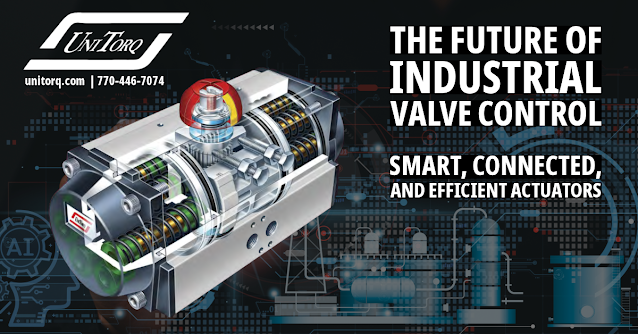
Over the next five years, the industrial valve actuator market will undergo significant transformations driven by advances in artificial intelligence (AI), wireless communications, and industrial digitalization. These technologies will revolutionize how pneumatic and electric valve actuators operate, enabling enhanced efficiency, reliability, and connectivity in various industrial applications.

Artificial Intelligence Integration

Integrating AI into valve actuators will enable predictive maintenance and intelligent decision-making. AI algorithms can predict potential failures and optimize maintenance schedules by analyzing real-time data from sensors and historical performance records. Thus, they will minimize downtime, reduce maintenance costs, and extend the lifespan of valve actuators. Additionally, AI-powered actuators can self-learn and adapt to changing process conditions, ensuring optimal performance and energy efficiency.

Wireless Communication Advancements

Adopting advanced wireless communication technologies, such as 5G and IoT (Internet of Things), will revolutionize valve actuator connectivity. Wireless communication will enable remote monitoring, control, and diagnostics of valve actuators, eliminating the need for physical site visits, improving operational efficiency, reducing response times, and enhancing safety in hazardous environments. Wireless networks will also facilitate seamless integration with other industrial devices and control systems, enabling real-time data exchange and collaborative decision-making.

Industrial Digitalization

The increasing digitalization of industrial processes will profoundly impact valve actuators. Digital twins, virtual replicas of physical assets, will become more prevalent. These digital models will simulate the behavior of valve actuators under various conditions, enabling predictive maintenance, performance optimization, and virtual commissioning. Cloud-based platforms allow centralized data storage, analysis, and remote access, facilitating data-driven decision-making and cross-functional collaboration.

Cybersecurity Enhancements

As valve actuators become more connected and digitized, cybersecurity will be a critical consideration. Manufacturers will invest in robust security measures, such as encryption, secure communication protocols, and user authentication, to protect valve actuators from cyber threats. Regular security updates and patches will be essential to address evolving vulnerabilities and maintain the integrity of industrial control systems.

Modular and Interoperable Designs

Valve actuator designs will evolve towards modular and interoperable architectures. Modular designs allow easy customization, upgradability, and maintenance, enabling end-users to adapt actuators to specific application requirements. Interoperability will ensure seamless integration with various industrial protocols and control systems, promoting flexibility and reducing integration costs.

Sustainability and Energy Efficiency

Sustainability and energy efficiency will be critical drivers in the development of valve actuators. Manufacturers will focus on designing actuators with reduced power consumption, improved materials, and optimized performance. Advanced control algorithms and energy recovery systems will further enhance energy efficiency. Additionally, adopting eco-friendly materials and manufacturing processes will reduce valve actuators' environmental impact.

The next five years will witness significant advancements in pneumatic and electric industrial valve actuators driven by AI, wireless communications, and industrial digitalization. These technologies will enable predictive maintenance, remote monitoring, and intelligent decision-making, improving efficiency, reliability, and connectivity. As the industry embraces these advancements, valve actuators will become more innovative, secure, and sustainable, revolutionizing how industrial processes are controlled and optimized.

UniTorq Actuators and Controls
2150 Boggs Road, Suite 410
Duluth, GA 30096
https://unitorq.com
Phone: (770) 446-7074
Fax: (770) 447-1825

Distinguishing Between Quarter-Turn and Multi-Turn Electric Actuators in Valve Operation

Difference Between Quarter-Turn Electric Actuators and Multi-Turn Electric Actuators

Quarter-Turn Electric Actuators

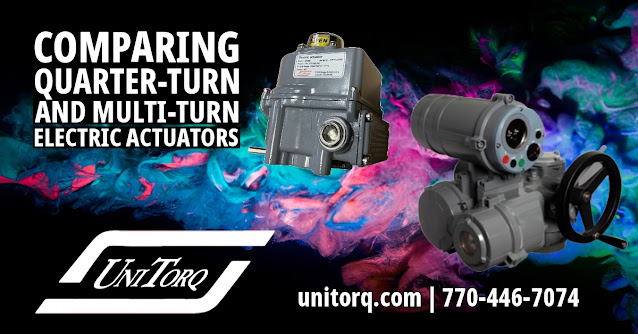
These actuators enable a valve to rotate 90 degrees, which is one-quarter of a full circle, hence the name. The mechanism inside a quarter-turn electric actuator typically employs a motor that drives gears to convert the motor's rotational movement into the 90-degree valve turn. These actuators are commonly found mounted on ball, plug, and butterfly valves.

A ball valve, for instance, has a ball with a hole in its center. When the actuator turns the ball to align the hole with the pipeline, it allows flow. Conversely, when it turns the ball so the hole sits perpendicular to the pipeline, it stops the flow. Similarly, a butterfly valve has a disc mounted on a rotating shaft. When the disc is parallel to the flow of liquid or gas, it lets the medium pass. Rotating it 90 degrees blocks the flow.

Multi-Turn Electric Actuators

As the name suggests, multi-turn electric actuators provide multiple rotations. These actuators often have mechanisms that allow the motor's continuous rotational motion to interface with valves requiring multiple turns to move from the open to closed positions or vice versa. Gate, globe, and some types of linear stem valves are ideal examples of where multi-turn actuators find their application.

For instance, consider a gate valve. It has a gate or wedge that moves up or down to obstruct or allow flow. This movement is not a simple rotation but requires multiple stem turns to ensure the gate fully ascends or descends. A multi-turn electric actuator provides this function. When the actuator motor rotates, it has a threaded stem that moves linearly, raising or lowering the valve's gate. A similar operation exists for globe valves, where the stem and the attached disc or plug move linearly up and down to regulate flow.

In summary, quarter-turn electric actuators serve valves that need a 90-degree rotation, such as ball, plug, and butterfly valves. In contrast, multi-turn electric actuators cater to those valves that demand multiple rotations, like gate and globe valves. The choice between the two depends heavily on the specific valve type and the desired control mechanism in the industrial setup.

UniTorq Actuators and Controls
2150 Boggs Road, Suite 410
Duluth, GA 30096
https://unitorq.com
Phone: (770) 446-7074
Fax: (770) 447-1825

UniTorq Unleashed: High-Performance Valve Automation

UniTorq Unleashed: High-Performance Valve Automation

Industrial valve automation is pivotal in optimizing processes and ensuring safety across numerous sectors. From petrochemical plants to wastewater treatment facilities, the precise control of liquids and gases hinges on the flawless operation of automated valves. Proper valve automation ensures that substances flow at the correct rate, pressure, and direction, which is not just a matter of efficiency but often safety. Any oversight or malfunction can result in leaks, overflows, or even catastrophic system failures, posing risks to equipment, the environment, and, most importantly, human lives.

Furthermore, in an era where industries continually seek to enhance productivity and reduce downtime, efficient valve automation acts as the linchpin. When correctly integrated and maintained, automated valves minimize manual interventions, reduce human error, and enable rapid responses to changing conditions, streamlining operations and bolstering the reliability and longevity of industrial systems. In essence, proper industrial valve automation is not a mere convenience—it's imperative for safety and optimal operational performance.

UniTorq stands prominently in the valve actuator industry, consistently delivering electric and pneumatic solutions. Many in the field recognize UniTorq's commitment to quality, precision, and innovative approaches. The company values detail-oriented work and places a strong emphasis on customer satisfaction.  They've expanded their services to encompass complete valve automation. From accurately sizing actuators to assembling valves and actuators, it undergoes meticulous attention and rigorous testing in every process stage. Those who collaborate with UniTorq find more than just a product; they discover a partnership rooted in expertise enriched by years of experience.

To learn more about UniTorq valve automation services, visit this link.

UniTorq
770-446-7074